
This audio is auto-generated. Please let us know if you have feedback.
LinkedIn has published a new report on the state of artificial intelligence adoption in business, according to Blake Lawit, the platform’s chief global affairs and legal officer.
The report, titled “Skills and AI: The U.S. Workforce Imperative,” discusses the opportunities for U.S. organizations in taking up AI tools, in order to maximize efficiency.
LinkedIn’s report also includes policy and partnership recommendations to help facilitate AI adoption, and open the doors for broader acceptance of AI systems. The research covers all the economic and professional implications of the AI shift, and highlights the key opportunities, with the data indicating that widespread adoption of AI “could unlock up to $4.1 trillion in productive capacity for the United States.” That is, of course, if the right regulatory steps are in place to optimize for such.
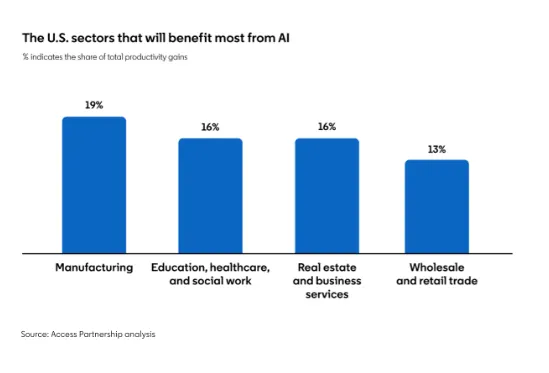
As shown in this image, the report looks at where AI can be most beneficial within the U.S. economy, with manufacturing, education and real estate being the top three sectors that LinkedIn’s data indicates will benefit from broader AI usage.
As per the report, which cites multiple sources including previous LinkedIn research as well as research from AccessPartnership: “Early adopters of AI in the U.S. are already demonstrating its significant potential to improve productivity. Perhaps most notable is that U.S. businesses save an average of 8.7% of working hours each week through the use of AI. And more than half of businesses say AI tools are helping them automate repetitive tasks and simplify processes, including 53% of small businesses.”
Yet, despite U.S. companies leading the way on AI development, the report noted that U.S. businesses are lagging behind other regions in AI adoption. The report stated that around half of U.S. businesses have adopted AI tools, which is 20% lower than the share of Indian businesses who have done so. Citing Microsoft’s latest AI diffusion report, LinkedIn said that only 28% of America’s working age adults use AI.
That means that America is falling behind in AI adoption, which could eventually see the nation lagging in maximizing AI efficiencies.
The LinkedIn report recommended that U.S. employers take more steps to upskill employees in the latest AI tools, while also prompting U.S. government agencies to implement support for certification programs to validate AI competencies.
The report also recommends that the government look to implement higher education programs focused on AI, in order to facilitate broader training. That would also support AI upskilling programs in partnership with employers, to boost professional AI literacy, the report said.
The data here raises some interesting notes, although it is worth noting counter studies such as a Harvard Business Review report, which showed that while AI tools can expand the opportunities for business development, they can also lead to overwhelm due to intensifying workloads. Meanwhile, those tools often don’t provide the efficiencies promised.
Indeed, a recent study published by the National Bureau of Economic Research found that among nearly 6,000 CEOs, chief financial officers and other executives, the vast majority have seen little impact from AI on their operations.
As per that study: “Firms report little impact of AI over the last 3 years, with over 80% of firms reporting no impact on either employment or productivity.”
That could be related to educational gaps, as highlighted in LinkedIn’s report, but it may also reflect broader issues with AI adoption, as well as with AI tools failing to deliver on their promises of massive gains.
The LinkedIn report highlights some worthy considerations nonetheless, and the combined scope of feedback showed that more needs to be done to maximize any potential gains from AI tools.