

Tucker Carlson and influencers peddle wild nicotine claims, from curing rabies to purging nanotech
Published

(Photo illustration by Salon / Getty Images / ANDREW CABALLERO-REYNOLDS / Nestea06)
Nicotine, the addictive drug present in tobacco, is having a moment — and not just as the pleasurable buzz most people seek but as the latest wellness craze. Especially in a certain corner of the podcast world, everyone from self-styled doctors to pundits are pushing nicotine, claiming that it’s an overlooked cure-all with shocking health benefits, delving into the murky and increasingly political question of what constitutes medical misinformation. Some claim that a nicotine foot soak can cure atrial fibrillation, others say that the drug can be a treatment for erectile dysfunction, and some have even taken the next step, selling tobacco products of their own.
When former Fox News personality Tucker Carlson appeared on a recent episode of Theo Von’s “This Past Weekend,” the conversation quickly turned to Carlson’s brand of nicotine pouches, ALP.
ALP, a relatively new player on the nicotine product scene, is a collaboration between Carlson and Turning Point Brands, the tobacco giant that offers products from Zig Zag rolling papers to Stoker’s snuff. (It has no relation to the conservative nonprofit Turning Point USA.) In the interview, Carlson explains that he decided to jump into the tobacco business after receiving a letter from Phillip Morris International, one of the world’s largest tobacco companies, for a comment he’d made in 2024.
He claimed that Zyn, one of their smokeless pouch products, could be used as an erectile dysfunction remedy. According to Carlson, the company asked him not to make any claims about the alleged medical benefits of Zyns, whether or not those comments are a joke. At the time, Phillip Morris said that it does not partner with any influencers to promote its products.
The reaction from Phillip Morris is what might have been expected, at least a few years ago. A lawsuit against JUUL, a once dominant e-cigarette company, looms large over the tobacco industry’s marketing strategy. In 2023, the company settled a lawsuit for nearly half a billion dollars after six states and Washington, D.C. sued the company for laws related to the marketing of tobacco products. The company admitted no wrongdoing in the settlement.
Carlson, however, apparently feels differently about making claims about the alleged benefits of nicotine, even after his dust-up with Phillip Morris. Speaking with Von, Carlson praised the alleged benefits of nicotine use, saying, “Nicotine is super important; this country’s gotten far sadder and less healthy since it was discouraged, and it’s coming back. And I think it shows, like, people are just happier.” Carlson did not respond to Salon’s request for comment.
And, it’s not the only time the new nicotine merchant has lavished praise on the drug. In one post on his Instagram, he called nicotine a “life-enhancing God-given chemical,” and elsewhere, he’s described it as a sort of cure-all that will make you “feel better than you’ve ever felt.”
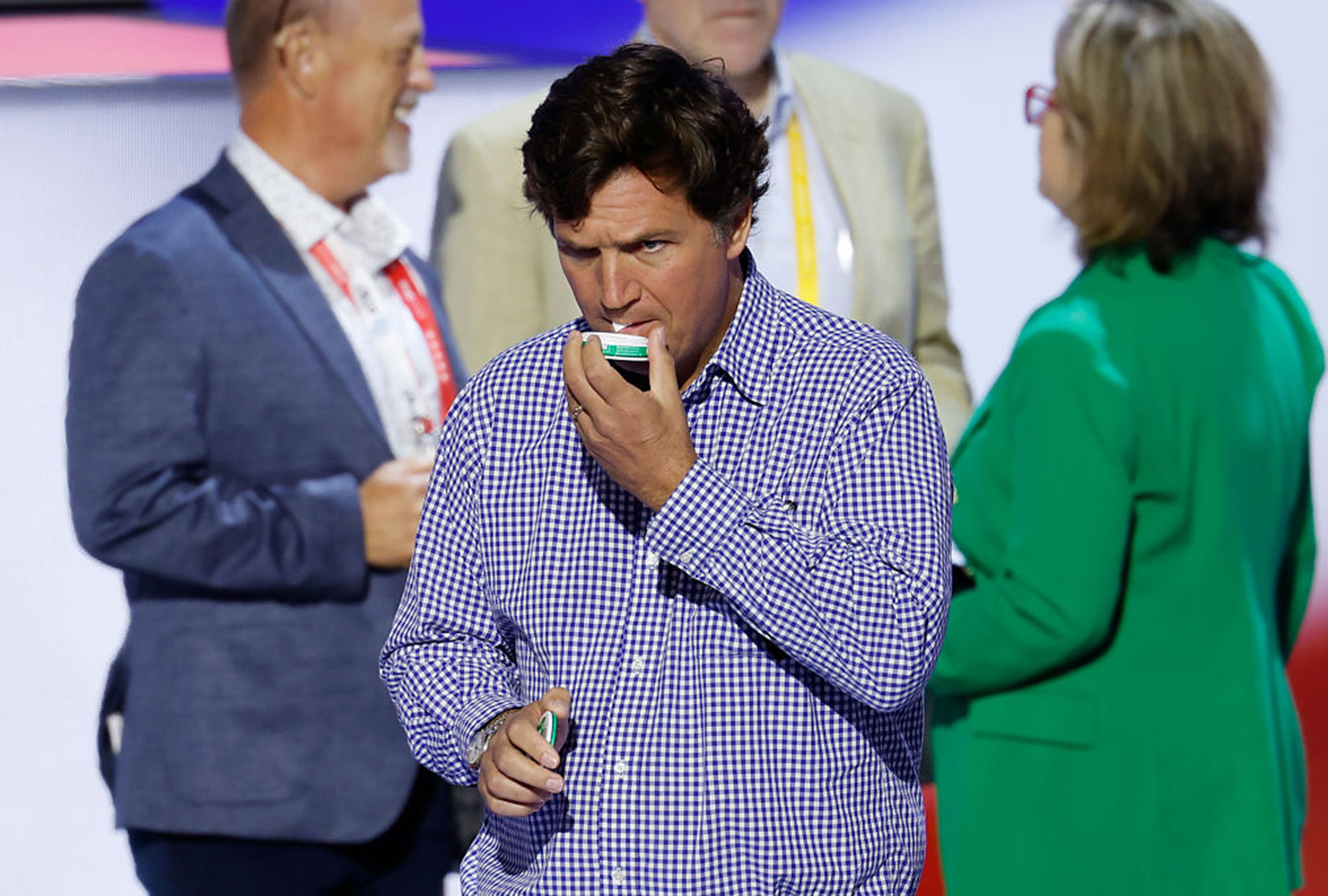
(Chip Somodevilla / Getty Images) Tucker Carlson holds a pack of nicotine pouches during preparations for the fourth day of the Republican National Convention at the Fiserv Forum on July 18, 2024 in Milwaukee, Wisconsin.
The language Carlson throws around about nicotine could potentially expose him and the company to legal risk, according to Daniel Aaron, who served as assistant chief counsel at the Food and Drug Administration during the Biden Administration, though that depends if the government were interested in pursuing it.
“You can’t have your CEO go out and say that some drug ingredient or some tobacco ingredient is amazing when that’s the exact ingredient you’re selling.”
“Since Tucker Carlson owns such a huge stake in ALP I think it’s pretty arguable that this is part of the company’s marketing campaign,” Aaron said in an interview with Salon. “You can’t have your CEO go out and say that some drug ingredient or some tobacco ingredient is amazing when that’s the exact ingredient you’re selling, and then say that that’s not part of your advertising and promotion. It just doesn’t make sense.”
Aaron pointed to what he says is an even bigger problem with ALP: the fact that it’s not authorized by the FDA. While the FDA announced in September that it was fast-tracking the authorization for a host of nicotine pouches, to date only 13 pouch products from two companies have been authorized for market in the United States. Most of these are Zyn. And, according to the FDA, only those products that have been authorized can be legally marketed.
This is different from FDA approval — the FDA does not “approve” any tobacco products, saying on their website “There’s no such thing as a safe tobacco product, so the FDA’s safe and effective standard for evaluating medical products does not apply to tobacco products. … A marketing authorization does not indicate that the tobacco product is either safe or ‘approved.’ It means that the manufacturer has complied with the requirements under the law to bring its product to market.”
Without authorization, products like ALP are subject to FDA enforcement, which can include fines and warning letters. Whether technically legal or not, Carlson’s claims about nicotine improving mood or nether-region blood flow are far from alone. Many others in the podcast world are hyping nicotine, some with even more outlandish claims.
Over the past few years, content concerning the alleged benefits of nicotine has proliferated, especially in right-wing spaces. Most commonly, these discussions focus on the claimed cognitive benefits of nicotine.
For example, an episode of the “Shawn Ryan Show” from last year concerned itself with what the show billed as “the nicotine debate,” with the show’s host, Shawn Ryan, having Gabrielle Lyon, a licensed physician, on as a guest.
“Nicotine is amazing,” Lyon said. “I personally love nicotine. And it has to be used discretionary. What are some of its benefits? When I was doing my fellowship at WashU in geriatrics … We ran a memory and aging clinic and so the things that were coming up on how do you make people more cognitively robust, what are the studies, what are we looking at for new data coming out. And one of the papers that came across my desk was in fact nicotine. It was nicotine improving cognitive function in Alzheimer’s and potentially Parkinson’s.”
Urban Kieran, a podcast host with a Ph.D. in bio-analytical chemistry, is another example of a podcaster pushing nicotine while giving the appearance of being a medical doctor.
“Nicotine though is actually biochemically enormously beneficial to an individual, and in fact I don’t even smoke and I’m wearing a 7mg patch right now,” Urban said on an episode of Decoding Health last year, describing nicotine as a “supplement” and not a drug.
Urban went on to claim that nicotine could treat long COVID, a condition in which COVID symptoms last for months or even years. Urban asked “this is something I got to ask the question are they trying to sweep this under the rug or is it just something which they want to be able to control and monetize?”
“We’re pretty clear that nicotine is not some smart drug or panacea for the normal range of human behavior and cognition.”
While medical-themed influencers pushing nicotine have proliferated in recent years, perhaps none have achieved the prominence of wellness influencer Bryan Ardis, who is becoming increasingly known as some podcasters’ favorite “expert” on nicotine. Ardis, who typically goes by Dr. Bryan Ardis, though he does not have a medical degree, is a chiropractor with a doctorate of chiropractic from Parker University in Texas.
On a 2025 episode of Alex Clark’s “Culture Apothecary,” Ardis advocated for nicotine use, not just as a way to get a buzz, but as a cure for ailments ranging from whooping cough to atrial fibrillation. He went as far to say the drug could dissolve nanotechnology, alleging microchips are in the COVID vaccines, and thus nicotine “could single-handedly protect all of humanity.”
Ardis’ claims are far-reaching; he claims people absorb nicotine from nightshade vegetables like potatoes and tomatoes, that he knows an oncologist who cured a six-year old’s cold with a nicotine patch and he claims that rabies and HIV can be cured by nicotine. Ardis has also claimed that people with A-fib can soak their feet in a tobacco leaf tea, and expect their condition, or other heart conditions like tachycardia, to disappear “forever.”
“Nicotine is releasing poisons out of the heart and correcting arrhythmias,” Ardis said.
Many of his claims have a kernel of truth to them. For example, potatoes and tomatoes do contain nicotine, but the amount and bioavailability mean that it’s not absorbed in the same way that nicotine is from, say, a nicotine pouch. Some research suggests that nicotine can tone down the aggression caused by rabies, making it less likely to spread from one host to another, but that’s far from a claim like taking nicotine will cure the virus, which has a nearly 100% fatality rate. Similarly, there has been some research into why HIV-positive smokers may have a harder time quitting tobacco, especially on certain medications that enhance nicotine metabolism. There has also been research into the way that certain types of tobacco have been used in Indigenous medical practices, though the existing research has been focused on documenting the practice rather than evaluating clinical outcomes. Ardis did not respond to a request for comment from Salon.
The problem for claims like the one Ardis makes is that they are spun far out beyond what there is actual evidence for. Paul Newhouse, the director of the Center for Cognitive Medicine at Vanderbilt University Medical Center and one of the leading researchers when it comes to nicotine research, told Salon that “we cannot realistically make any positive health claims for nicotine other than stopping smoking.”
“Nicotine is a plant alkaloid. It activates specific receptors in the body and particularly the brain, where it has a variety of interesting effects which affect neurotransmitter function across the brain, and there are clearly cognitive and behavioral effects of nicotine — but that does not translate into therapeutic benefit in most cases,” Newhouse said.
Newhouse’s own research is focused on whether nicotine might have potential as a treatment for certain types of cognitive impairment and memory loss, but he says for people whose brains are functioning normally, “there is little to no evidence that nicotine can improve normal cognitive or emotional function.”
He often describes the cognitive effects of nicotine as functioning along a U-shaped curve. For people with impaired cognitive function, there is some evidence that it might help them, but for people with normal cognitive function, the drug will actually “likely make it worse.”
“We’re pretty clear that nicotine is not some smart drug or panacea for the normal range of human behavior and cognition,” Newhouse said.
Newhouse concluded that the various academic curiosities about nicotine being explored by members of the medical community are basically beside the point for members of the general public and that, unless someone is trying to quit using tobacco, there’s no medical reason to start using a nicotine product, especially considering that in most clinical settings nicotine is administered via a patch, not an oral product like a pouch or vape, which can be much more addictive.
“We can show in laboratory experiments that nicotine enhances certain aspects of cognitive function and certain aspects of emotional processing, but to translate that to therapeutic benefit is a whole ‘nother piece of work, and that’s been much more difficult to do,” Newhouse said.
It’s worth noting that, though the FDA considers all nicotine products to be tobacco products, regardless of whether they contain tobacco or if the nicotine is derived from tobacco. Tobacco itself has a variety of naturally-occurring toxic chemicals in it. These include heavy metals like cadmium and lead. Many tobacco products and nicotine products also contain additives, often to impact taste or texture. These additives differ product to product.
Start your day with essential news from Salon.
Sign up for our free morning newsletter, Crash Course.
Richard Saver, a law professor at the University of North Carolina at Chapel Hill, told Salon that the definition of medical misinformation is sometimes murky and has, since the pandemic, often clashed with the feelings of conservatives, especially in state legislatures.
Saver said that state medical boards have been weary of disciplining practitioners since the pandemic, including state chiropractic boards, which fulfill a similar role to medical boards but for chiropractors. Theoretically, Saver said, medical and chiropractic boards are supposed to ensure that practitioners do not practice outside their area of expertise and training.
The ability of boards to exercise their oversight, however, has collided with Republican political interests in recent years. In Texas, where Ardis holds a current license to practice as a chiropractor, the legislature has threatened to defund the state medical board over one board member’s work with Planned Parenthood.
Saver explained that there are other issues with disciplining people when it comes to giving medical advice online. Doctors of medicine (and chiropractors) have a First Amendment right to speak, as does anyone else. Many medical boards are also typically wary of taking action that might stifle scientific debate. Saver said, for instance, medical boards might have suppressed discussions around the potential uses for medical cannabis in the past.
There are, however, more practical issues. For example, if someone hears a piece of medical advice online, and then decides to give their child nicotine who then becomes ill, it’s often hard to prove that any single online appearance persuaded that parent to give their child nicotine. All in all, Saver concluded, the problem of medical misinformation has run rampant since the pandemic.
“This was a sleeper issue that people did not pay much attention to before the pandemic. Then things got extremely intense,” Saver said. “I don’t mean to suggest that the legal tools are not there. They’re there. There’s a lot of complicated steps one would have to take, and that takes a willingness to do so.”
Related Topics
——————————————
Related Articles